
Artium Academy — 2025
Artium Academy — 2025
Referral Program Redesign
Referral Program Redesign
Referral Program Redesign
Artium's monthly active learners (~3,000) loved the product, but only 6.7% of them were sharing it with a friend. Here's what we did to turn that gap into a meaningful growth channel.
Artium's monthly active learners (~3,000) loved the product, but only 6.7% of them were sharing it with a friend. Here's what we did to turn that gap into a meaningful growth channel.
Artium's monthly active learners (~3,000) loved the product, but only 6.7% of them were sharing it with a friend. Here's what we did to turn that gap into a meaningful growth channel.
PLEASE OPEN IN DESKTOP TO
VIEW FULL CASE STUDY
Overview
Project
Project
details
details
Animations made using tools like:
LOTTIE ANIMATIONS & FIGMA MOTION
Animations made using tools like:
LOTTIE ANIMATIONS & FIGMA MOTION
Animations made using tools like:
LOTTIE ANIMATIONS & FIGMA MOTION
Context
About
Artium Academy
Artium's mission is to democratise graded music education: combine the depth of tradition with the reach of technology, on a simple three-step loop of Learn, Practice & Perform.



The Problem
Our learners
loved us, but…
During the last quarter of 2025, Artium set out to improve their overall conversions and revenue. And saw a troubling pattern; 93% of our monthly learners who loved us, gave us 4/5 star reviews, hadn’t shared a single referral with their friends.
0
0
Avg Monthly Active
Learners/Month

0
0
Avg. Learners Shared
Referrals with Friends/Month

0
0
Avg. Successful Enrollments
via Referrals/Month


The Brief and the Pushback
Leadership wanted a UI redesign,
we asked for a rebuild...
The original ask from leadership was a UI redesign, the existing screens were "not up to date," and we were asked to "make it look and sound exciting."
Shubhangi (PM) and I sat with the brief for a day and kept landing in the same place, no amount of exciting copy was going to fix a program whose rewards weren't motivating, whose structure had dead zones.
So we asked for a day or two to do some research and nail the real issue before touching any pixels. Two days later, the entire scope of the project had changed…

Qualitative Research
Analysing the
old experience
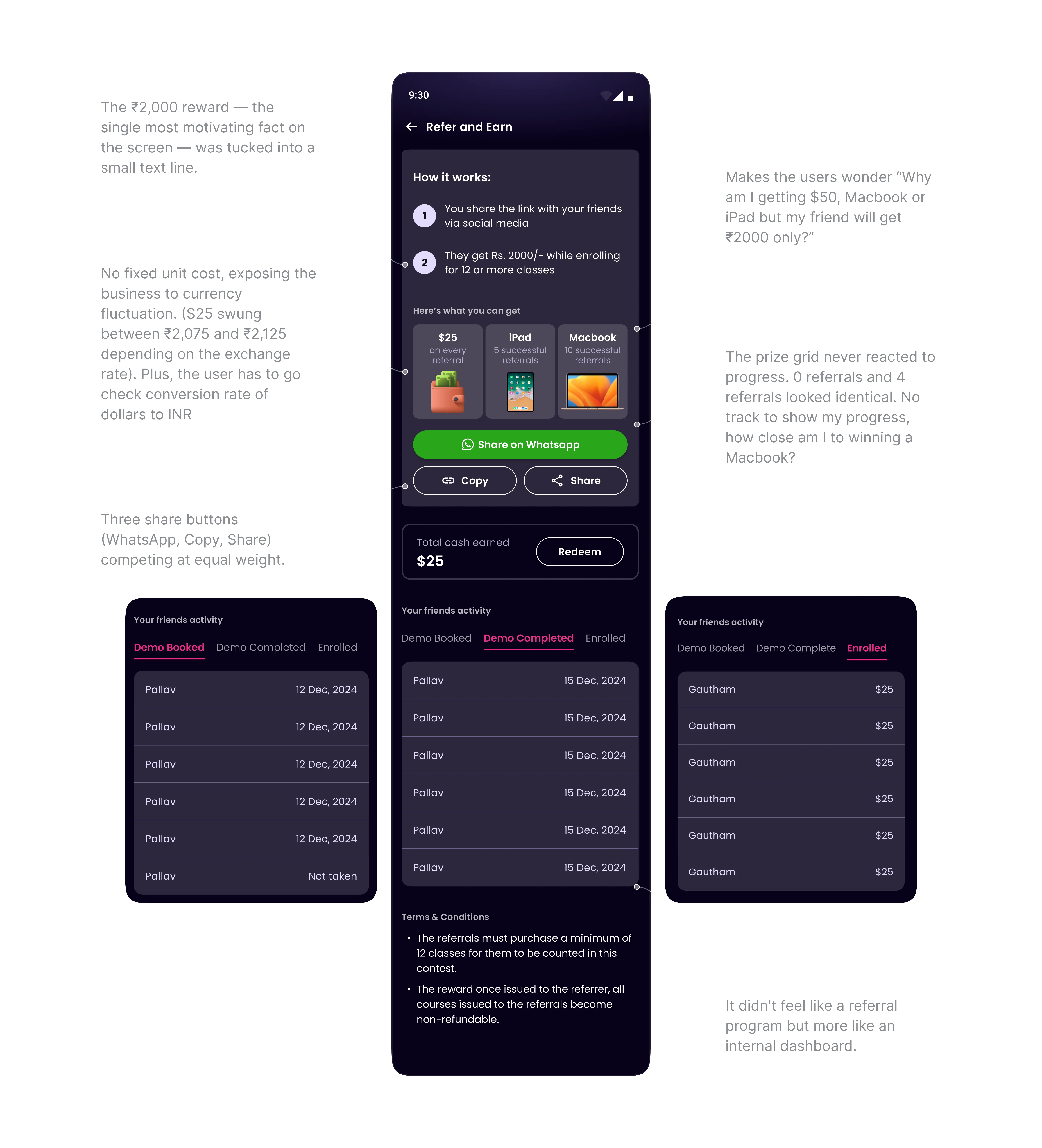
I audited the existing referral flow & found 6 concrete failures : 5 in the UI, and 1 in the program's economics itself:
Qualitative Research
Product Reviews on
Trustpilot
We wanted to see, if the users were unhappy & maybe that's why they were not referring…

Quantitative Research
Asking the right questions,
to the right people...

Our cohort: learners who had taken regular classes with us in the last 3 months & gave 4/5 stars reviews, but had shared zero referrals. This group was the most important signal - they had both the love and the intent, but we wanted to know what stopped them from referring!


Redefining Problem Statement
How might we...
Motivate learners to share referrals with their friends & also motivate
the friends of the learners to join our courses?
The Reward Rebuild
Designing a reward structure
that actually motivates learners...
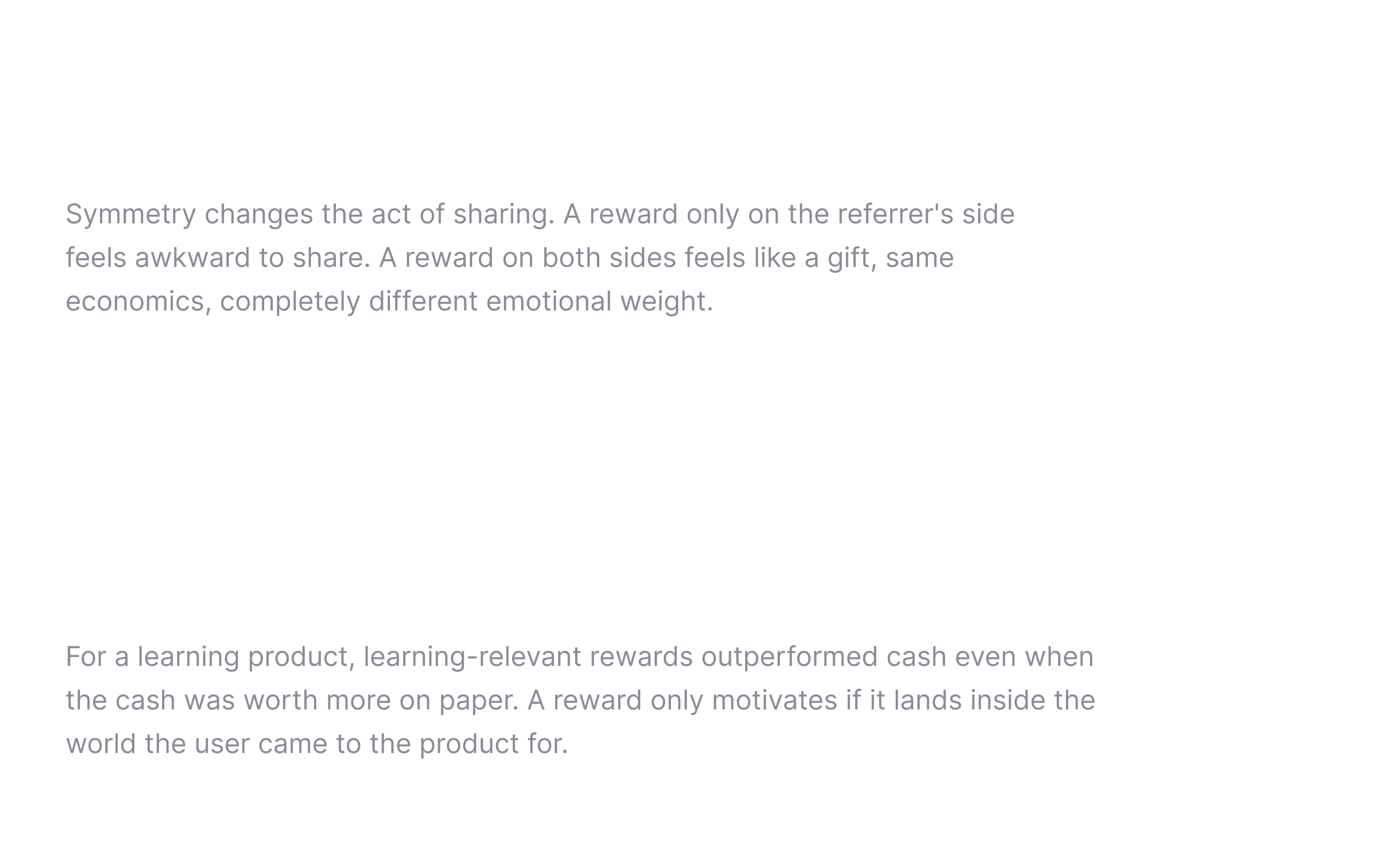
We started by writing down what a good reward had to do, not just for the learner, but for the business. Any option we considered had to sit inside this frame:


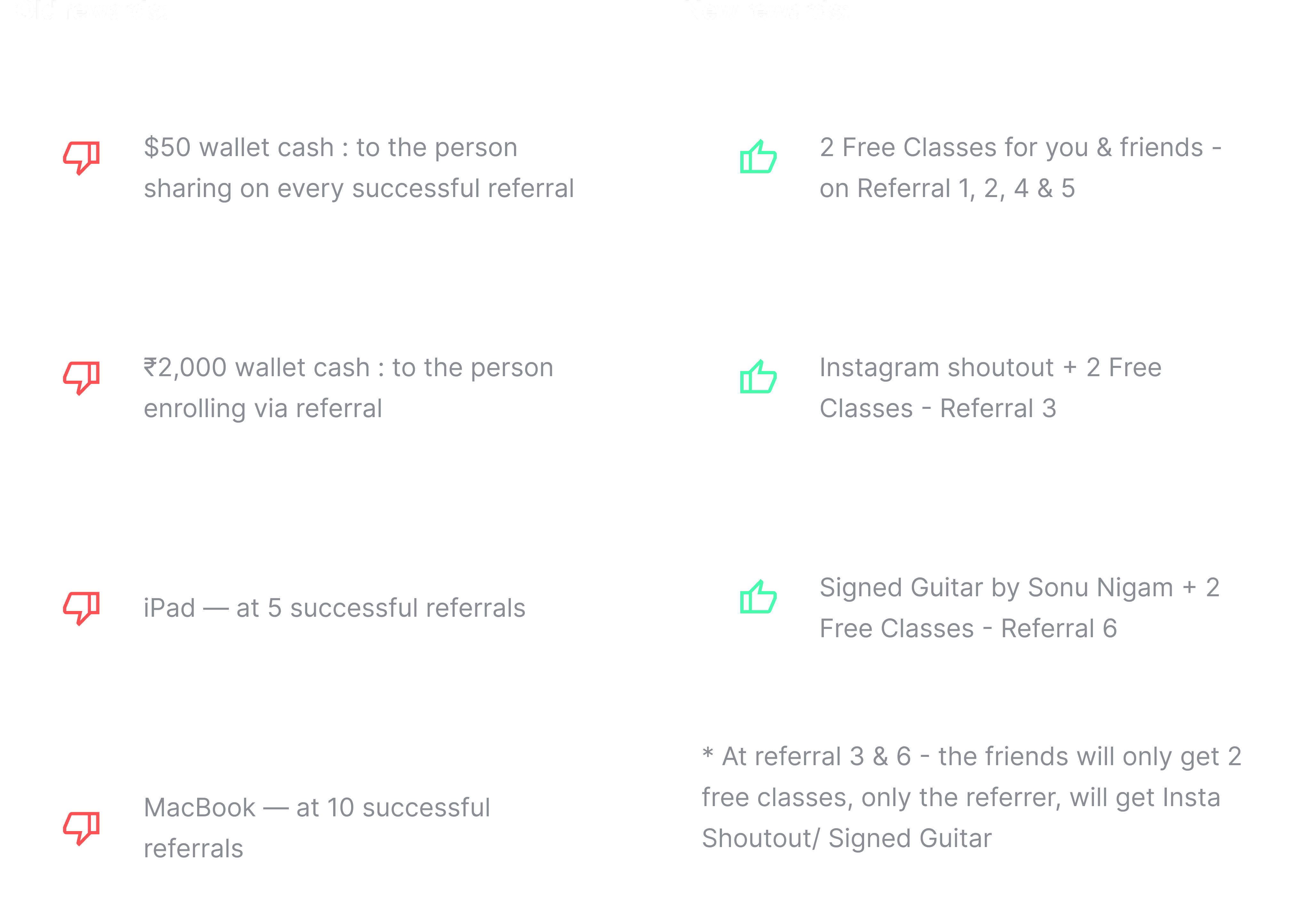
Visual Direction
Design
approaches
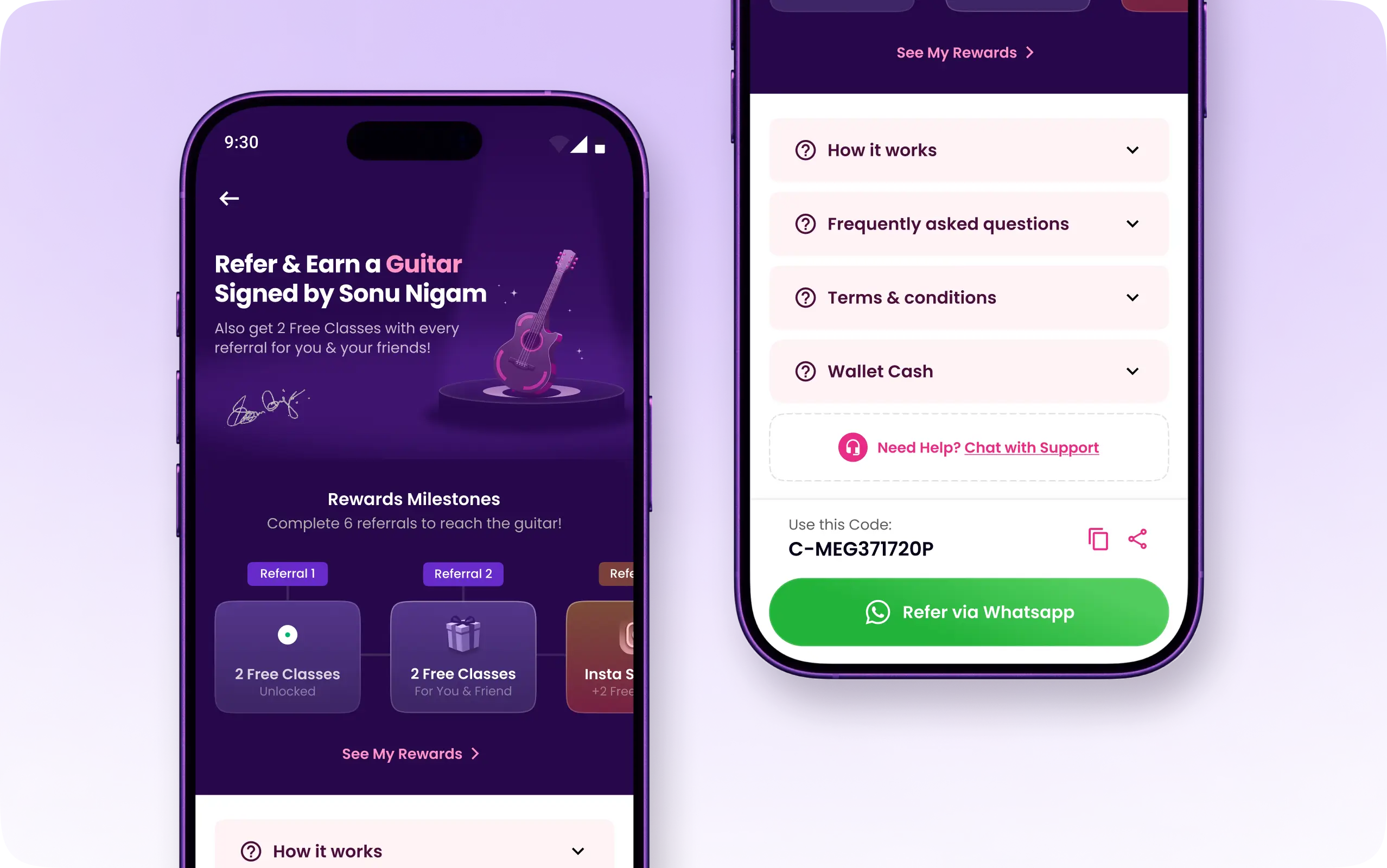
There was nothing in our design system that matched the "exciting" visual language I had in mind for the new program. So I did rapid prototyping & iterations using FIGMA MAKE AI.
For mobile, I had to create new components from scratch. For web, I found ways to reuse what we had.
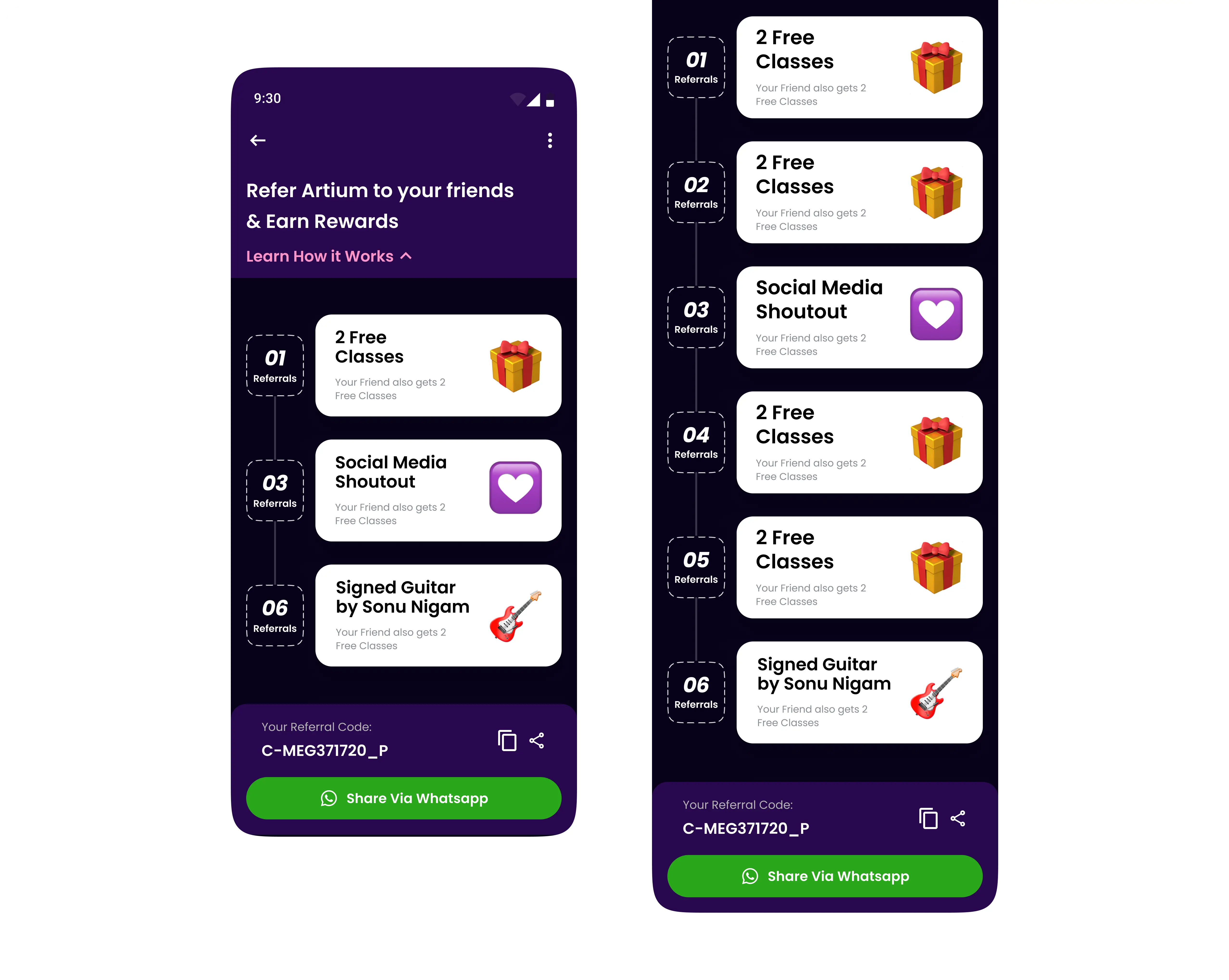
Approach 01 (Rejected):
A vertical layout gave each reward equal visual weight and followed a clean, predictable top-to-bottom reading pattern.
Approach 02 (Rejected):
A horizontal scroll freed vertical real estate, which we used to surface How It Works, FAQs, and T&Cs fully expanded on the same screen — no taps needed.
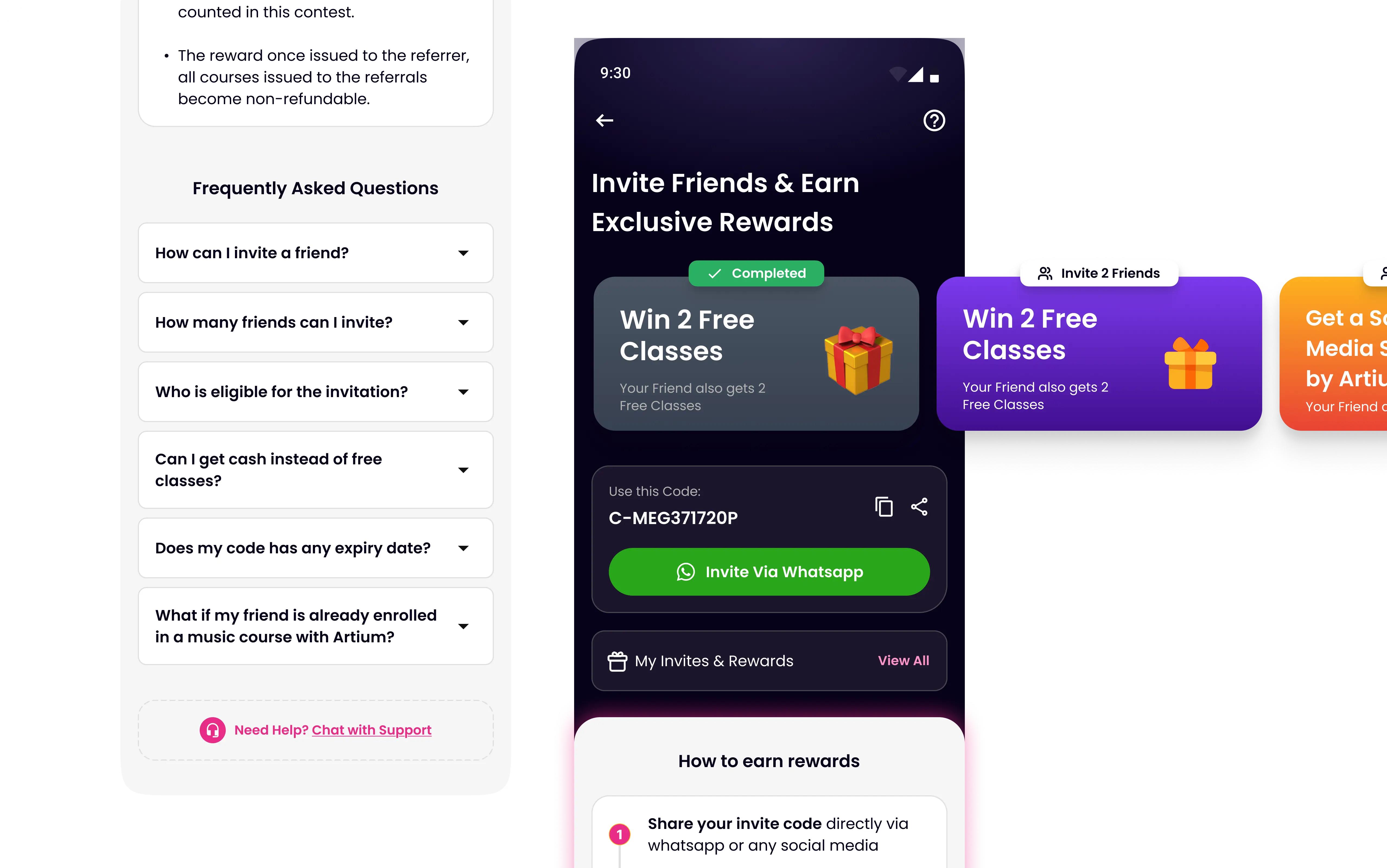
Approach 03 (Finalised):
A landing page with all the info, engaging in the first glance
without overwhelming the learners.

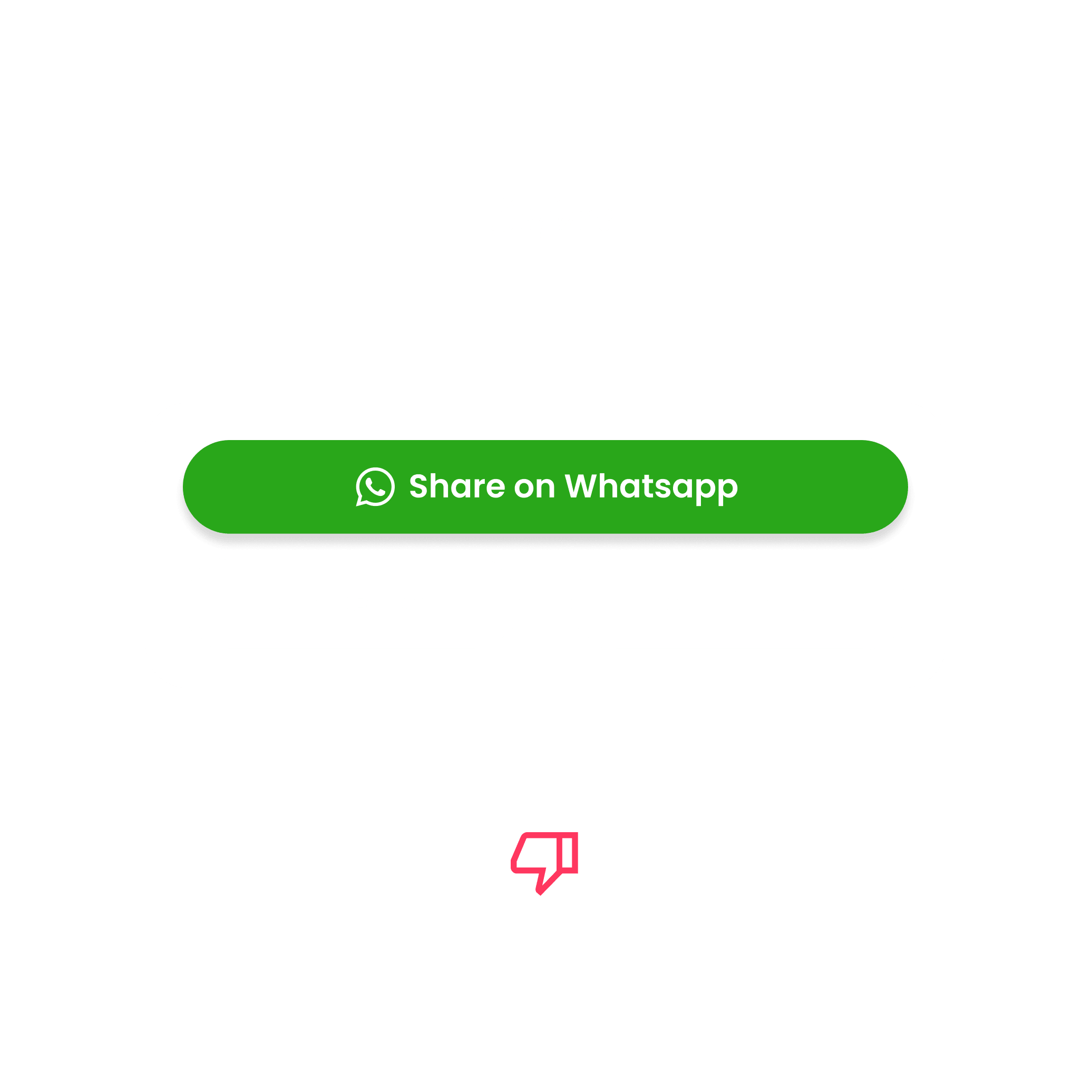
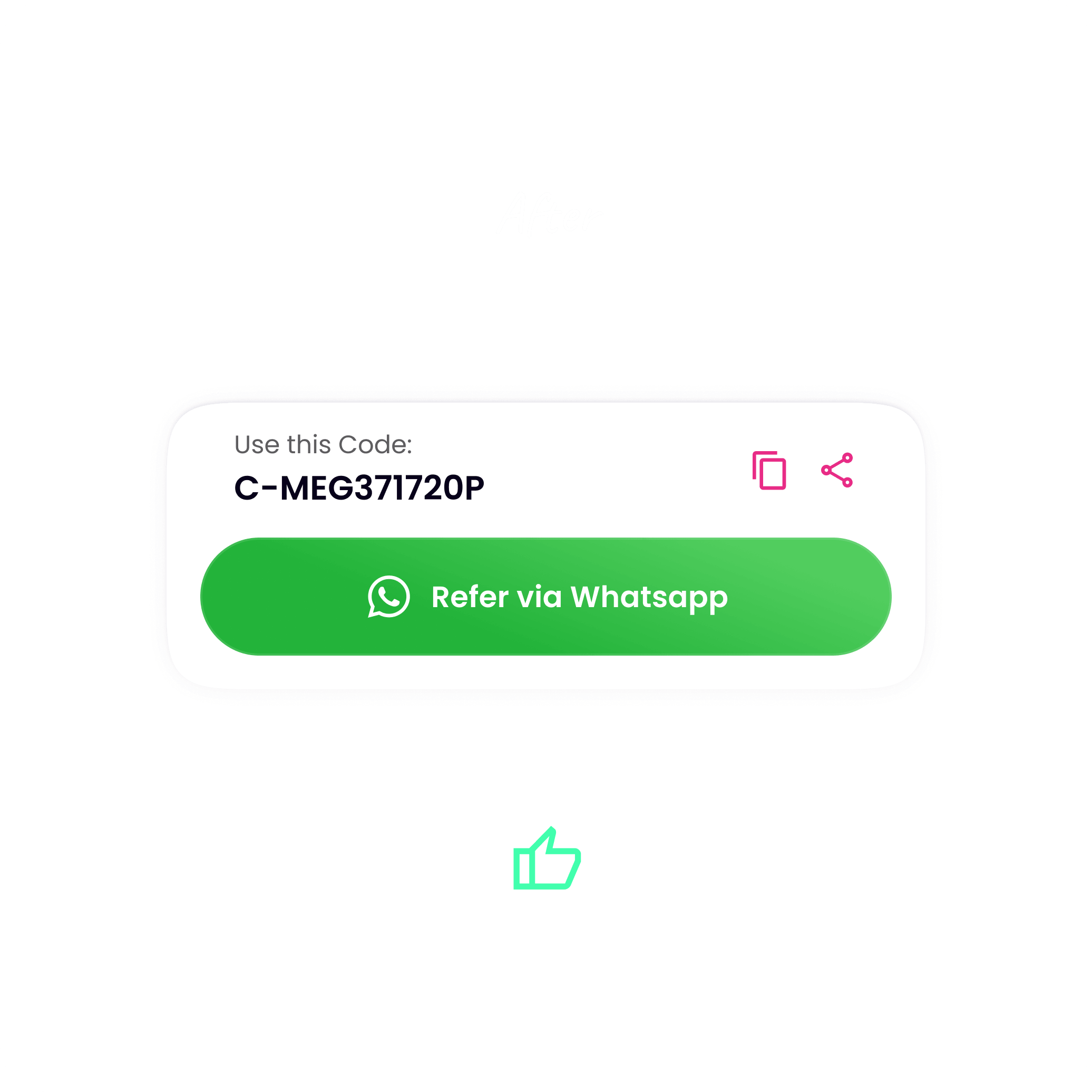
WhatsApp as the
single primary CTA:
A vertical layout gave each reward equal visual weight and followed a clean, predictable top-to-bottom reading pattern.
Dynamic
milestones
card:
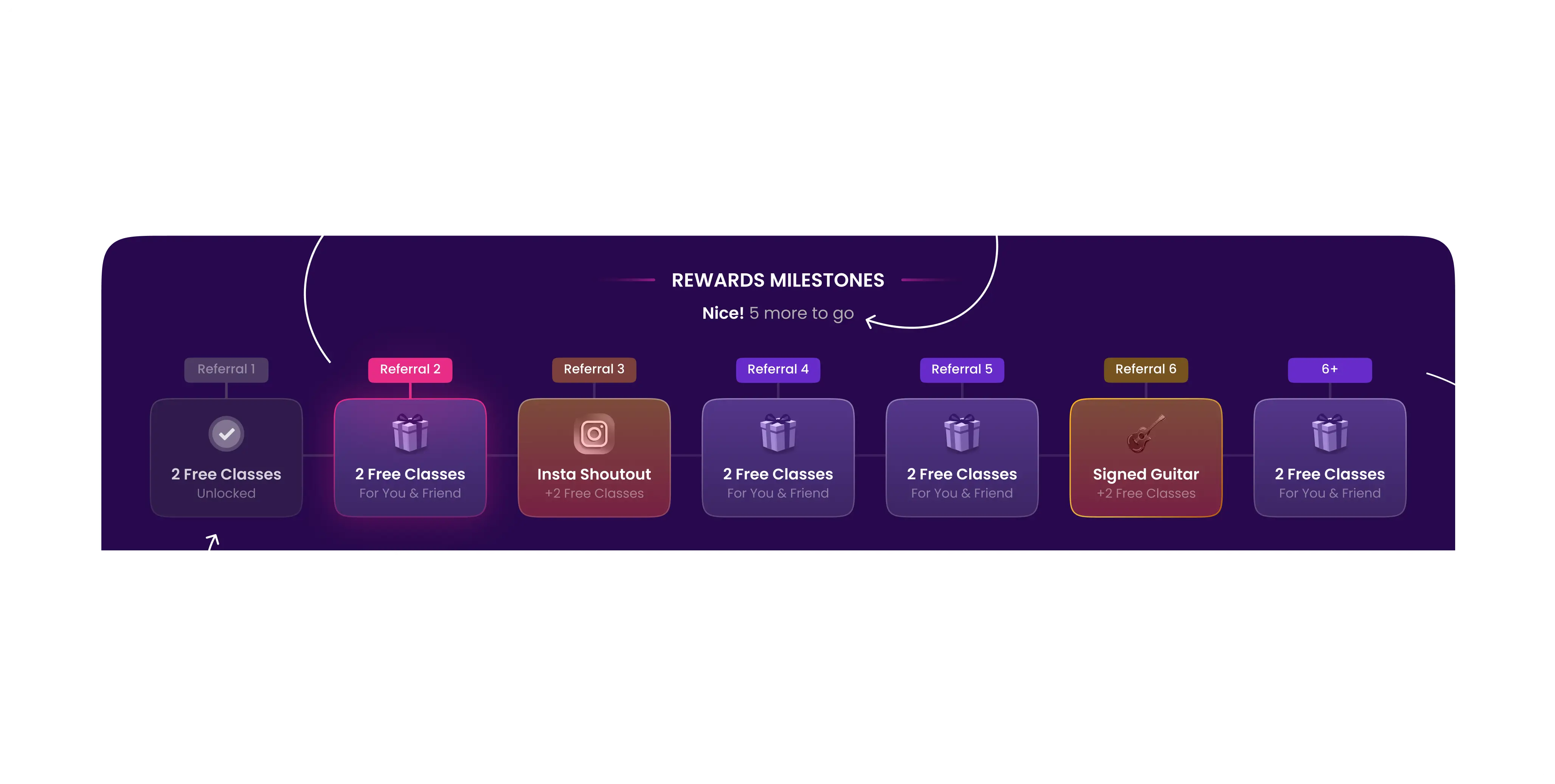
The milestones component was the most critical piece of the new landing screen from a readability standpoint. A lot of information in a small space and it had to change state as referrals completed. Scannability was everything.
Improvising on the
UX copy:
While dogfooding with the team, I noticed something subtle. The label "Referral 3" on a milestone card was confusing people, they kept reading "1 Referral" as "one referral" but "2 Referral" as "two more referrals after the first."
A small shift from "3 Referral" to "Referral 3" removed the ambiguity instantly. "3rd Referral" would have been even clearer, but screen real estate didn’t allow the space for it.


Optimising & reusing old components for web:
Once we locked the final designs for Mobile, I had to design the same for the web too, but unlike mobile, i was able to re-use the web components saving time for the web -development team.
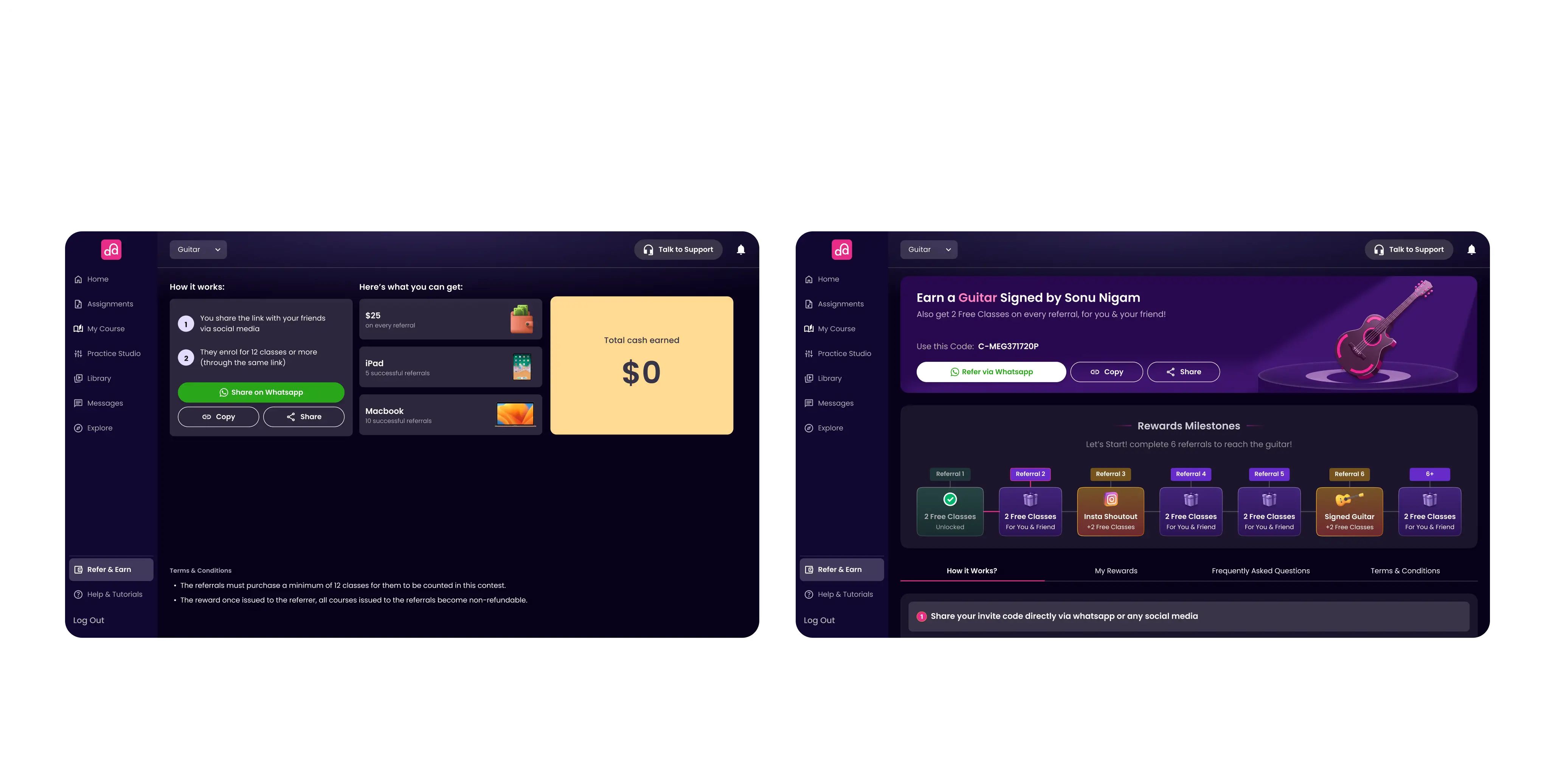
End To End Flow
An exciting experience
Please wait 5-10 seconds for the video to start!
Visual Design Direction
Celebrating wins, through
delightful animations...
I prototyped the celebration animations in Figma and exported them through LottieFiles, then handed the assets off to engineering as drop-in files, because building these from scratch wasn't in the dev budget. Packaging the motion as Lottie meant smooth collaboration between design and engineering, no back-and-forth on timing or easing, and no compromise on the delight factor.
Different animations for different unlocks:
Each milestone gets its own moment; sized to the magnitude of the reward. Small unlocks get a quick burst, big ones get a full celebration.
Additional Fixes
Going
beyond the brief...
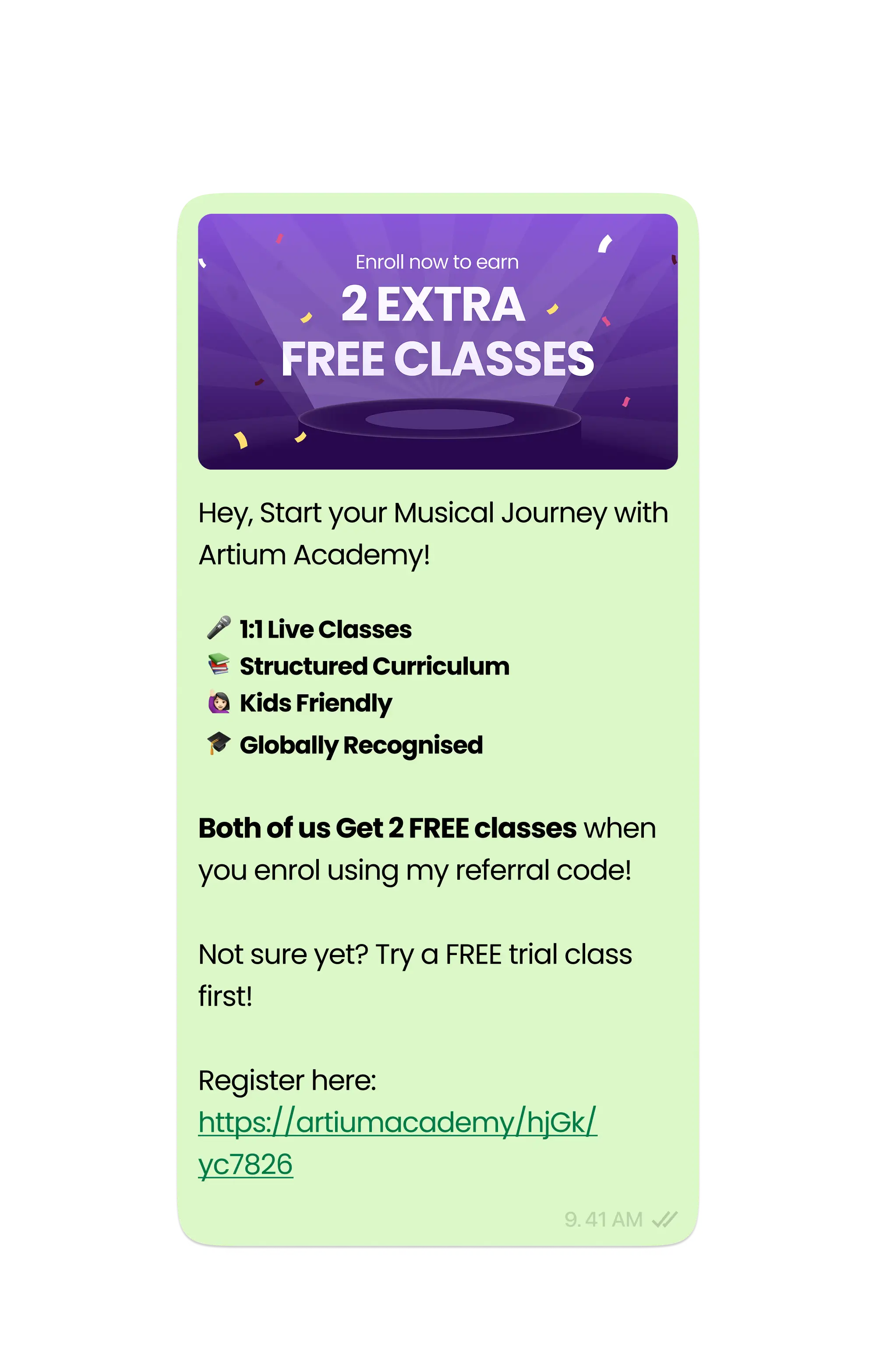
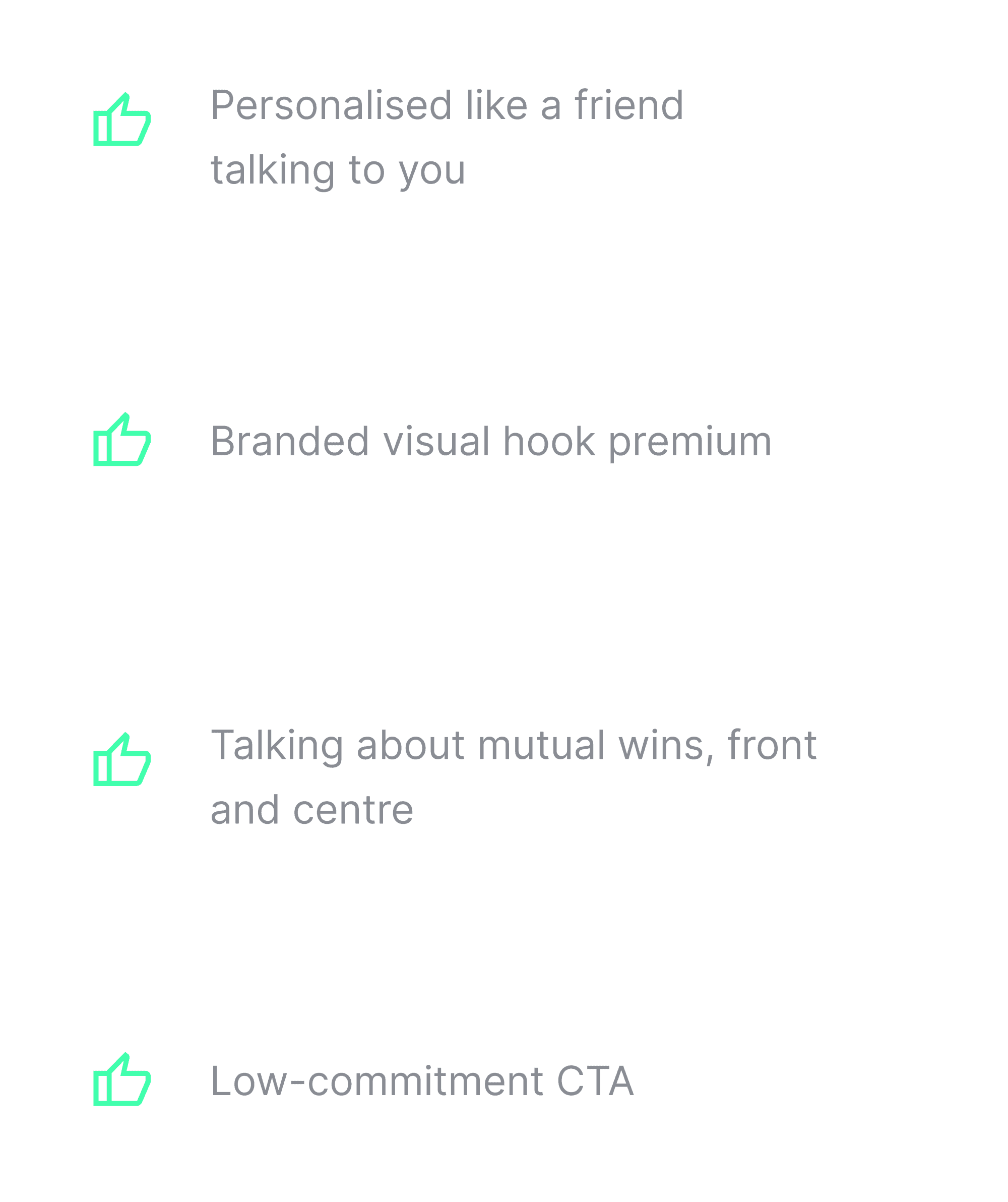
While testing the flows, I realised there was a big communication gap at the single most important moment, when a referrer actually shared the message with a friend. This is what they were sending:


The Results
What happened
after 30 days of launch?
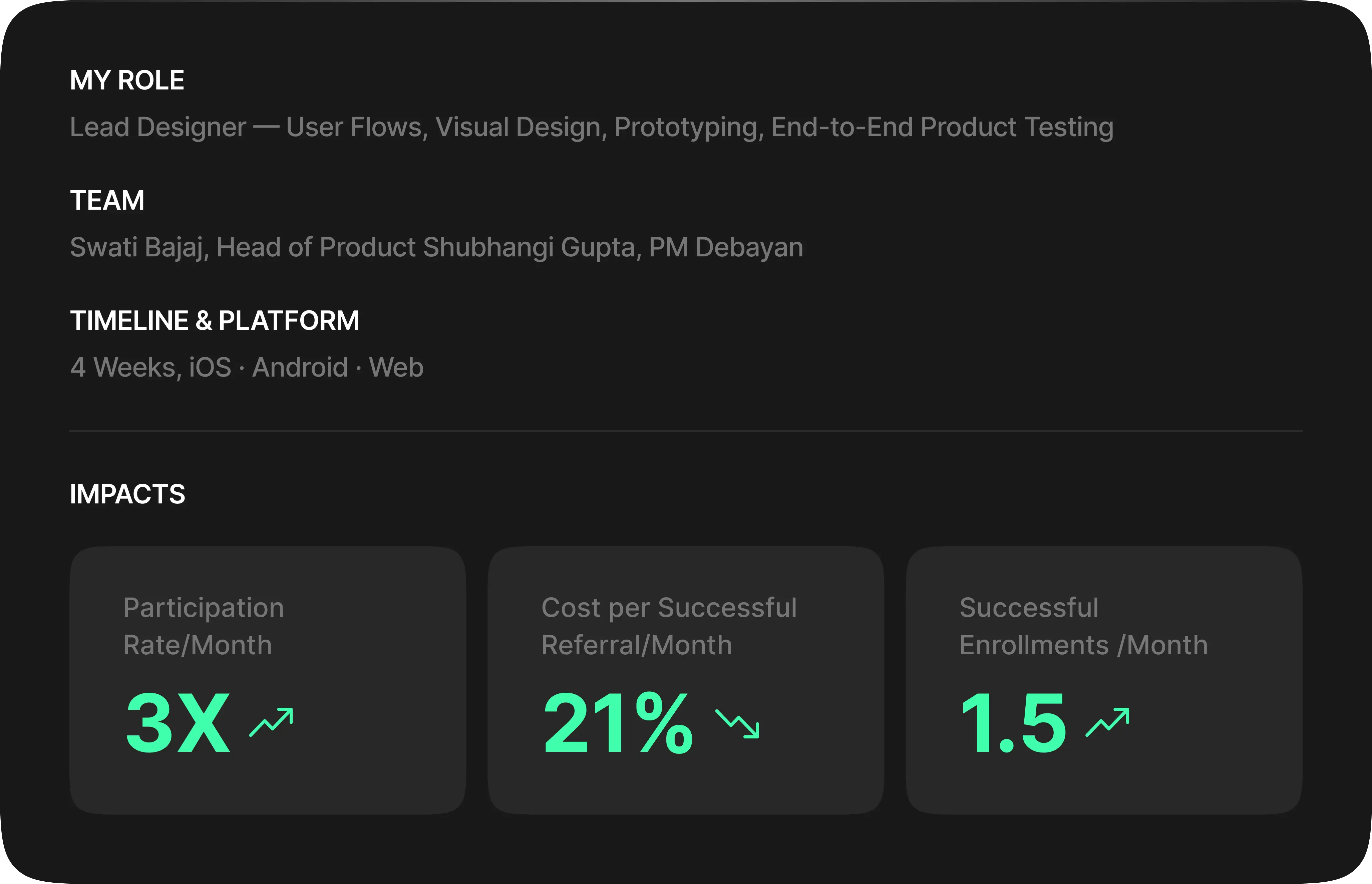
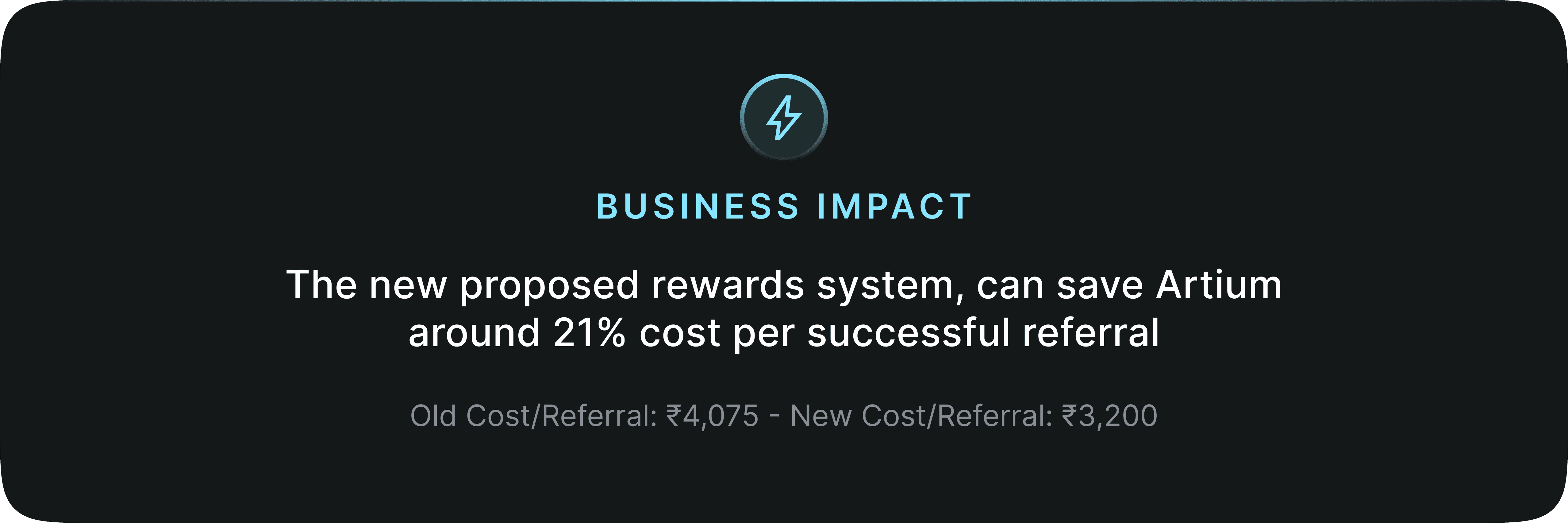
Our primary goal to improve the Participation rate was successful by 3x and Secondary goal of increasing enrollments via referrals, also increased by 1.5x. While also cutting down on Cost/Successful Referrals by 20% saving us

Conclusion
My
takeaways
Next
steps
That's all folks!
THANK YOU
OPEN IN DESKTOP TO VIEW FULL CASE STUDY